At a charity exhibition or event, a volunteer stands at a table. A donor arrives with cash or a card, and the volunteer jots the amount on paper and hands over a handwritten receipt. At the end of the day the charity sits in front of a pile of slips trying to work out how much was raised, for which campaign, and by whom. A donation collection point ends that mess: a cashier built for donations that records every gift against its campaign and prints a receipt in the charity's name. In this article we explain how it works in Najeed.
Why isn't a receipt book enough at events?
Manual collection looks simple, but it leaves gaps that show up later:
- Gifts with no campaign: the amount is logged as a lump sum and nobody knows which program it belongs to.
- Receipts that don't match the records: one goes missing or is written with the wrong amount.
- Late closing: management learns the day's total days later, and the accounting entry is delayed.
- Anonymous donors: the donor never reaches the charity's records or its impact report.
How does the collection point work in Najeed?
The charity store and points of sale module is an add-on to Najeed and includes a cashier for donations at the office, exhibitions and events. Its key features:
- One-tap giving: orphan sponsorship, a food basket or a general charity gift, at a fixed amount or one the donor chooses.
- Cash or card: with a donation receipt in the charity's name, and a "benefactor" option for donors who prefer not to be named.
- Documented gifts: every transaction is recorded as a donation against its campaign and appears in the donor's record and the impact report.
- Shift close: a total for each campaign, with the accounting entry.
So the volunteer works on a single screen, and what they record appears in the charity's system with no second entry.
The point-of-sale dashboard: what does management see?
Management gets a dashboard showing the cashier's activity. Here is a real screen from the demo system for a demo charity:
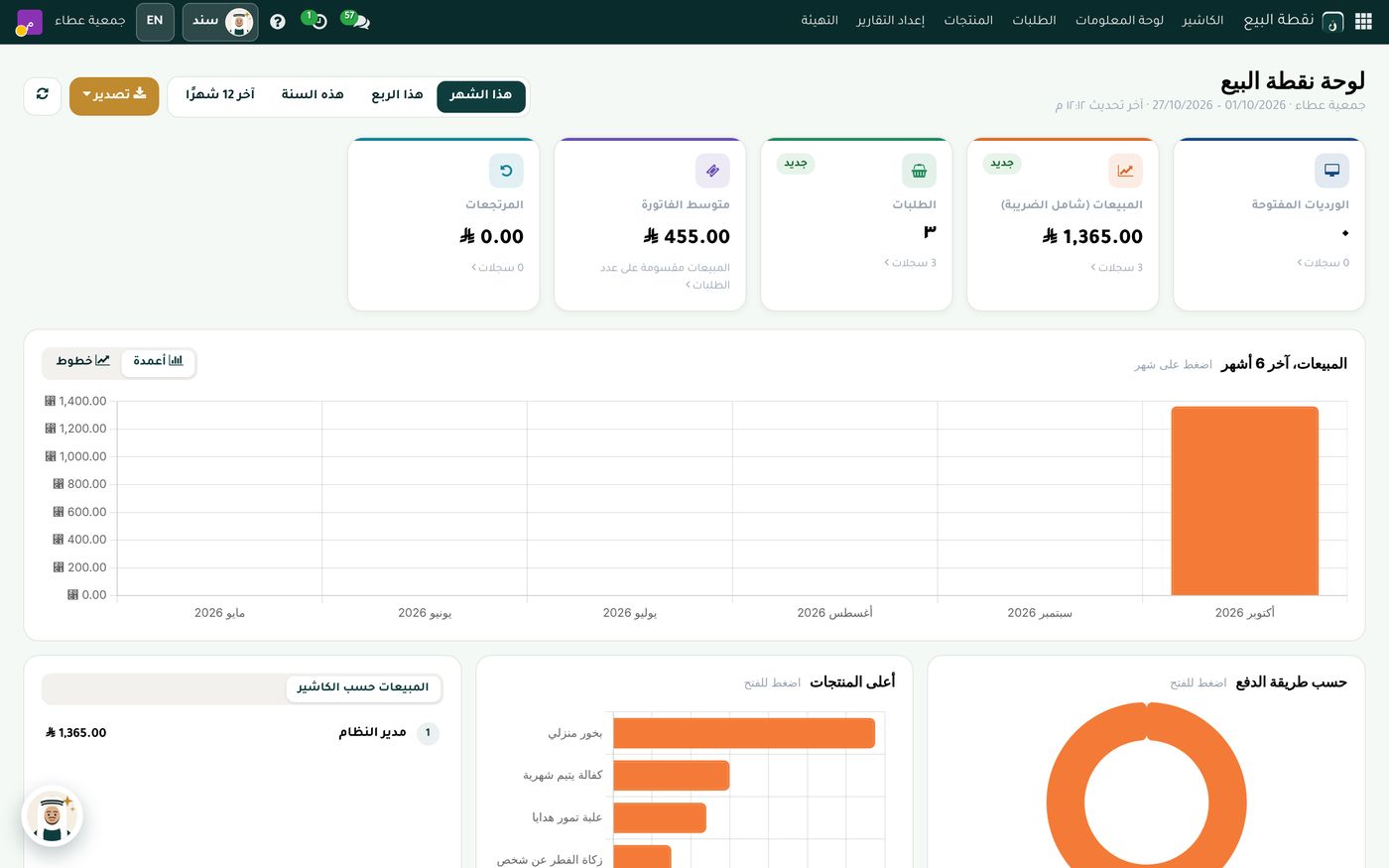
The figures on the screen are demo numbers, not a real charity's:
- Open shifts: zero right now, meaning no cashier is open at the moment.
- Sales including tax: 1,365 SAR across 3 records.
- Orders: 3 orders.
- Average order value: 455 SAR, which is sales divided by the number of orders.
- Returns: zero.
- Sales over the last 6 months: a single bar appears in October 2026, and the other months have no sales in this data.
You can switch the period between this month, this quarter, this year and the last 12 months, and export what you see when needed.
Products, payment methods and shifts
Scrolling down the dashboard shows more detail:
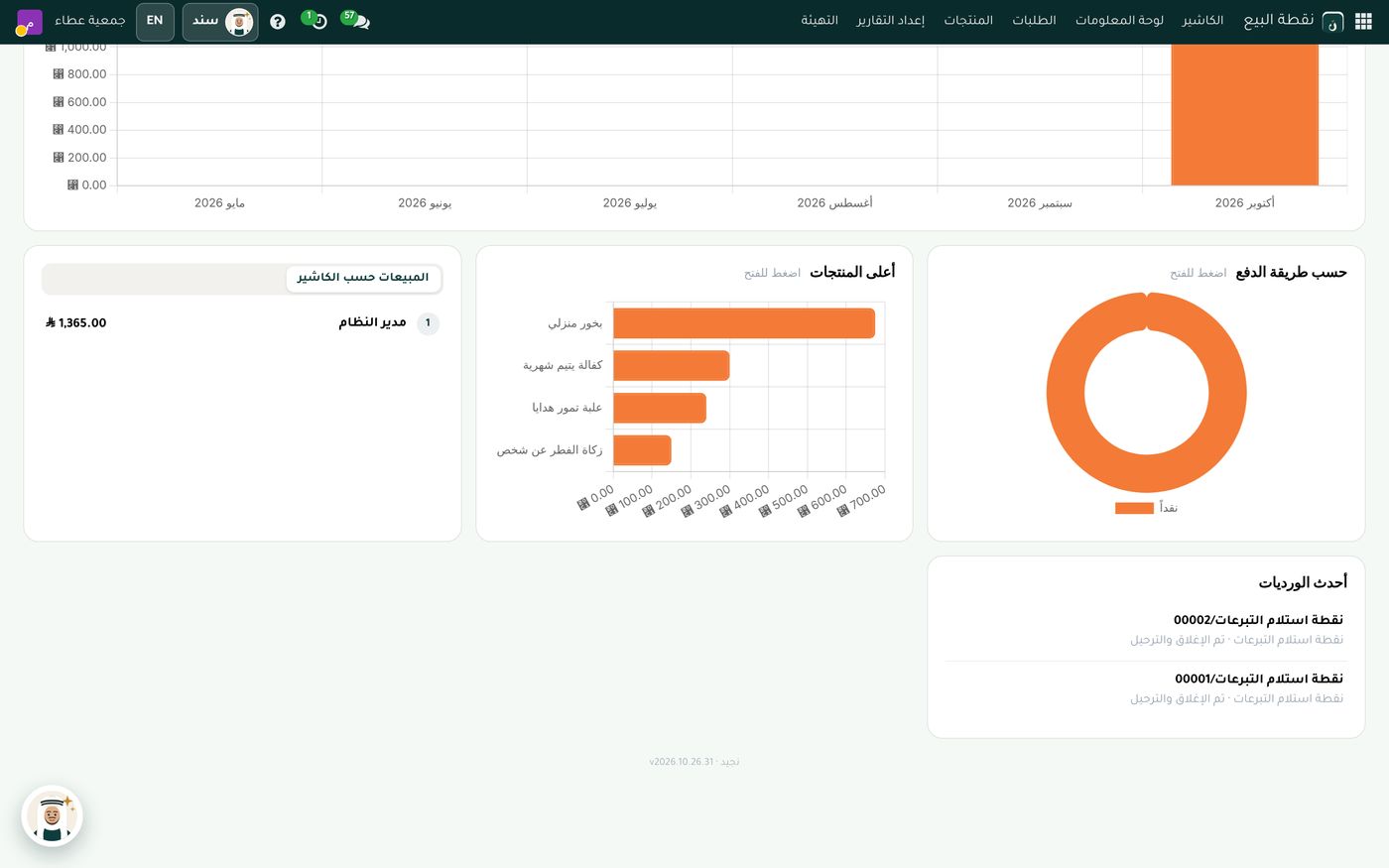
- By payment method: in this demo data every transaction is cash.
- Top products: home incense leads, followed by monthly orphan sponsorship, a gift box of dates, then Zakat al-Fitr per person. It shows that the cashier serves donations and products from supported families together.
- Sales by cashier: you see how much each cashier recorded.
- Latest shifts: two shifts named after the donation collection point, each marked as closed and posted to accounting.
A practical example: Zakat al-Fitr
The charity sets the Zakat amount per person, and the cashier enters the number of people in the family. The amounts are recorded in the Zakat campaign under a separate account, then distributed to eligible families before Eid prayer. The same approach works for sacrificial animals, iftar sponsorships and Ramadan food baskets. Because the campaign has its own account, its funds don't mix with anything else. For more on linking a gift to its campaign and its donor, read our article on donor management and campaigns.
A checklist before your next event
- Choose the giving products you'll offer: sponsorship, baskets, general gifts and so on.
- Link each product to its campaign so every gift is recorded in the right place.
- Train the volunteer to open a shift and issue a receipt.
- Close the shift at the end of the day and review each campaign's total.
- Open the dashboard and compare sales with previous events.
You can also use Sanad, a smart assistant dedicated to your organization, to answer your team's questions about these screens.
Summary
A donation collection point turns the table at an exhibition into an extension of the charity's system: one-tap giving, a receipt in the charity's name, a record against the campaign and the donor, and a shift close with an accounting entry. If your charity would like to see this on demo data, the Role8 team will be glad to show you.
Try Charity store and point of sale in Najeed
Try Najeed with demo data, or contact us and we'll set up the system for you.